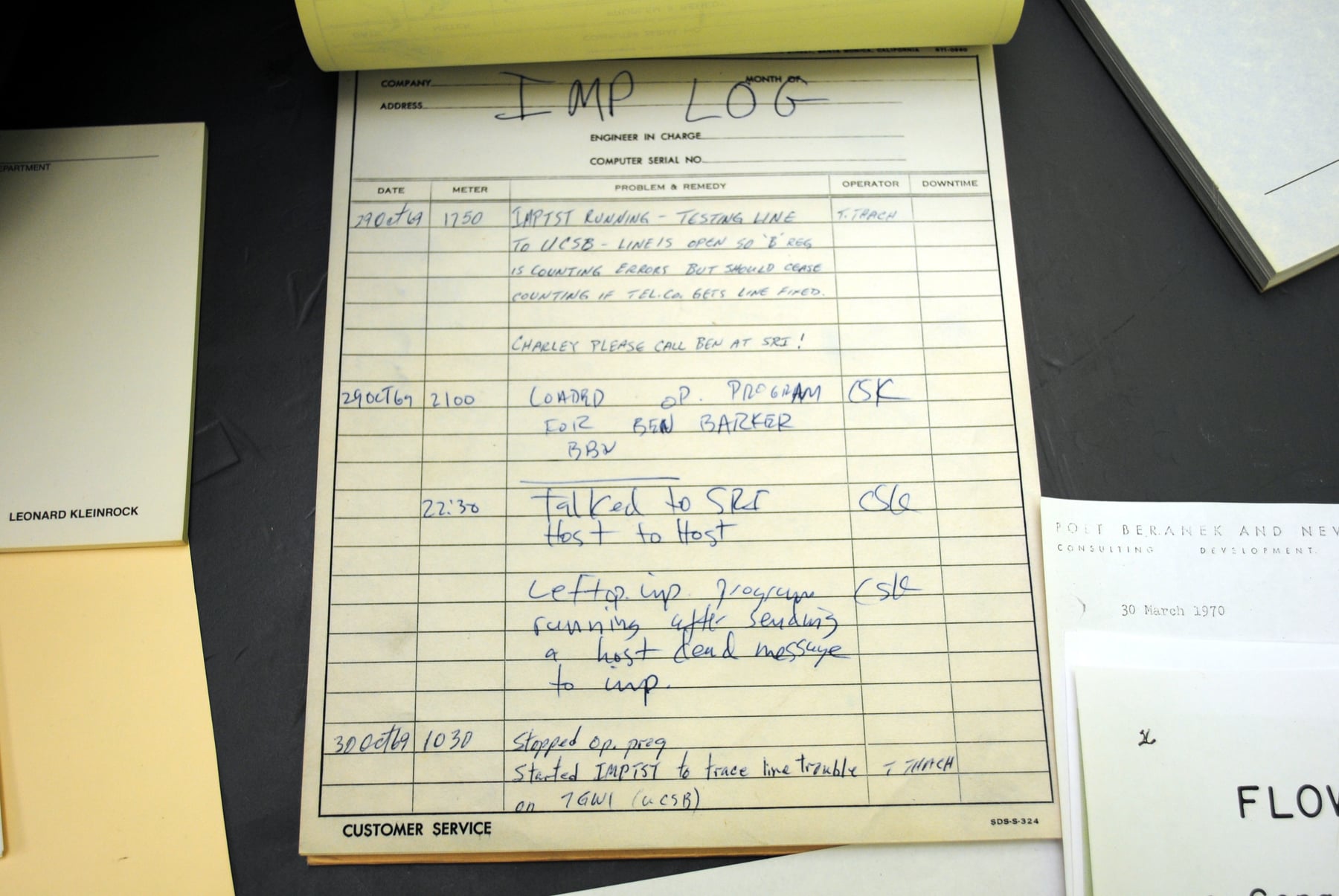
The first host-to-host message on ARPANET, a predecessor of the Internet, is meant to begin a remote login. The receiving computer crashes after two letters.
A historic conversation. Briefly.
On Wednesday evening, 29 October 1969, two programmers in California attempted a conversation between computers. They were also speaking by telephone, which turned out to be useful.
Charley Kline was at UCLA in Los Angeles. Bill Duvall was at Stanford Research Institute in Menlo Park, hundreds of miles away.
Their computers were different machines: an SDS Sigma 7 at UCLA and an SDS 940 at SRI. Experimental equipment called Interface Message Processors linked them to ARPANET, a research network supported by the U.S. Advanced Research Projects Agency.
Kline’s immediate objective was not to compose a message for posterity. He was trying to log in to the remote computer.
The intended command was LOGIN.
He typed L. Over the telephone, Duvall confirmed that it had arrived.
Then came O. That arrived too.
When Kline continued with G, the receiving system crashed.
The first host-to-host message on the new network had therefore reached the other end as LO.
Not a greeting selected by a committee. Not an announcement of the connected future. Just the beginning of a login that had not survived long enough to finish.
The failure was not permanent. The problem was corrected, and a successful login followed later that evening. Two computers in different places had demonstrated a connection—and, almost immediately, a reason to troubleshoot it.
There is a surviving paper record. UCLA’s handwritten IMP log contains a 22:30 entry recording contact with SRI.
The log establishes the recorded connection; it does not spell out LO or describe the crash. Those details come from participant accounts and institutional histories.
Nor do the accounts provide one perfectly consistent clock for the evening’s initial attempt and recovery. The story does not depend on selecting an undisputed minute: the date and failed-then-successful sequence are well documented.
One further distinction matters. This was ARPANET, an experimental predecessor of the modern Internet—not the first occasion on which any computers had exchanged information, and not the invention of the World Wide Web.
The milestone is substantial without enlarging it.
A foundational demonstration of remote computer communication began with two received letters, a crash and another attempt.
The connected future had arrived. It just needed the login fixed.
ARPANET’s first host-to-host message became memorable because the receiving system crashed before a remote login could be completed. An unintended two-letter fragment outlasted the technical fault that produced it.
The connection made history. The login needed another attempt.
Evidence status
Sources
Participant account and original log
UCLA / Leonard Kleinrock — The Day the Infant Internet Uttered its First Words
Original language: EnglishReceiving institution’s historical account
Original language: EnglishParticipant interviews and historical context
Computer History Museum — The First 50 Years of Living Online: ARPANET and Internet
Computer History Museum — 40th Anniversary of the First ARPANET Transmission
Original language: English