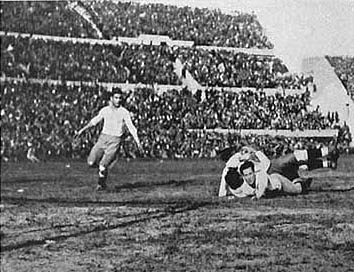
On Wednesday, 30 July 1930, Uruguay and Argentina met in Montevideo to decide the first FIFA World Cup. Before they could decide who was best at football, they first had to decide what football they were going to use.
One final. Two footballs.
The first World Cup had reached its final at the Estadio Centenario in Montevideo, with host nation Uruguay facing neighbouring Argentina.
There was, however, a problem before kickoff.
The teams could not agree on the match ball.
This was 1930, decades before World Cups came with standardized official balls supplied under global commercial contracts. Argentina and Uruguay had each been using balls they preferred, and when the two rivals reached the final, both wanted their own.
Neither side was inclined to surrender the point.
FIFA's accounts say the dispute required intervention. The solution was admirably simple and somewhat extraordinary: each team would get its ball for one half of the World Cup final.
Argentina's ball was used first.
Argentina went into halftime leading 2–1.
Then the football changed.
Uruguay's preferred ball was used for the second half, and the hosts scored three unanswered goals. Uruguay won 4–2 and became the first world champions.
It is tempting to credit the change of ball with changing the match. The scoreline certainly provides excellent material for that interpretation, but it does not prove causation. What can be said safely is stranger enough: the two halves of the first World Cup final really were played with different footballs because the finalists could not agree on one.
Modern World Cups build enormous branding campaigns around a single official match ball.
The first one settled the question by changing balls at halftime.
The first World Cup settled its first major equipment dispute by letting both sides win it.
Football found its first world champion before it found one ball everyone could agree on.
Evidence status
Sources
Primary / Institutional
FIFA — Uruguay conquer in battle of the balls
FIFA — Quirky stories from FIFA World Cup deciders
FIFA — history of World Cup match balls, including the 1930 Tiento / T-Model account
Original language: English / PortugueseIndependent / Reference
Library of Congress World Cup research guide — 1930 Uruguay tournament
RSSSF historical tournament record
Original language: EnglishMultilingual corroboration
FIFA Spanish historical coverage of the two-ball final
FIFA French historical coverage of the two-ball final
Original language: Spanish / French