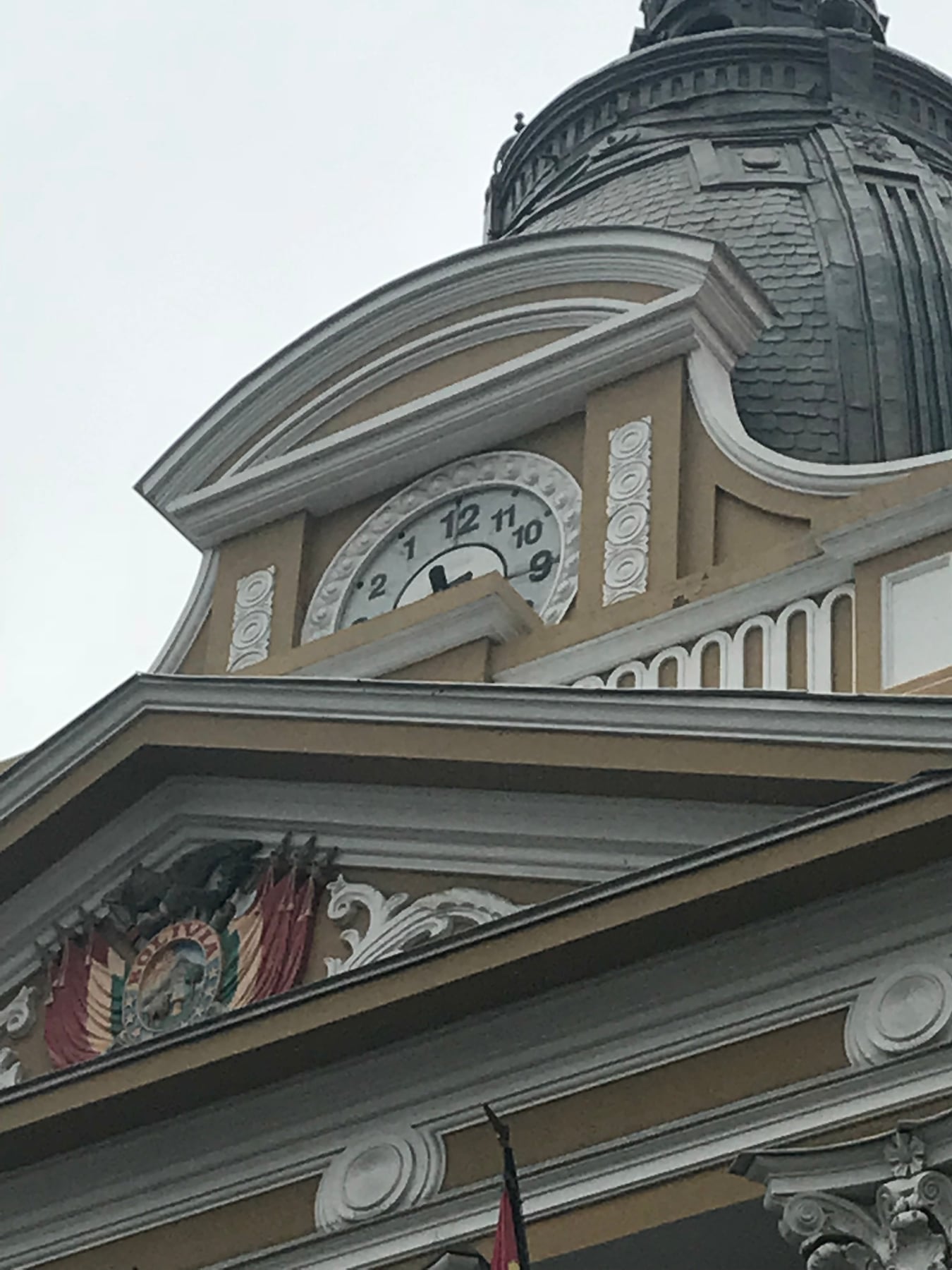
Bolivia reverses the numbers and hands of the clock on its Legislative Palace as a cultural and political statement. Eleven years later, the clock is changed back.
Same time. Opposite direction.
At midnight on Saturday, 21 June 2014, the clock on Bolivia’s Legislative Palace began presenting time differently.
Its hands moved counterclockwise. Its numerals had been rearranged to match.
The clock still told the time. It simply took the other route around the dial.
The building stands beside Plaza Murillo in La Paz. Its altered clock became known as the Reloj del Sur—the Clock of the South.
The change coincided with the Andean-Amazonian New Year. Foreign Minister David Choquehuanca explained its symbolism publicly on 24 June, three days after the new operation began.
Those dates are easily confused. June 24 and 25 appear on widely circulated reports, but contemporary Bolivian reporting places the actual start at 00:00 on June 21.
The distinction puts the event on Saturday, not on the weekday when an international reader first encountered it.
Choquehuanca presented the reversal as an expression of Southern Hemisphere identity and the recovery of Indigenous cultural perspectives. Why, he asked, should familiar conventions always be followed rather than reconsidered?
He also invoked the movement of a sundial’s shadow. That was part of his stated explanation, not a universal scientific rule that requires every clock south of the equator to turn left.
The intervention was a political and cultural symbol expressed through an everyday mechanical object.
It was not an attempt to reverse time.
Hours retained their ordinary length. Bolivia did not adopt a new civil time system, and the decision did not make every clock in the country run counterclockwise.
A familiar public dial had simply become less familiar. Contemporary reporting recorded objections from people around the square as well as the authorities’ defence of the idea.
The clock remained an unusually visible expression of that argument for more than eleven years.
On 6 November 2025, it returned to conventional clockwise operation. The change came shortly before a new president took office, during a wider political transition.
The numerals and hands were once again arranged the familiar way.
The country had not travelled backward through eleven years. Its parliamentary clock had travelled through two competing statements about direction.
First the reversal. Then the reversal of the reversal.
Bolivia turned a familiar clock convention into a cultural and political statement: the hands and numerals of its parliamentary clock ran in the opposite direction while ordinary civil time continued. Eleven years later, the change was reversed.
The clock changed direction twice. Time declined to follow.
Evidence status
Sources
Government’s contemporary explanation
Bolivian Foreign Ministry — Our clock is the Clock of the South · 24 June 2014
Original language: SpanishContemporary local reporting and start date
Oxígeno Digital — Public responses to the reversed parliamentary clock · June 2014
Original language: Spanish