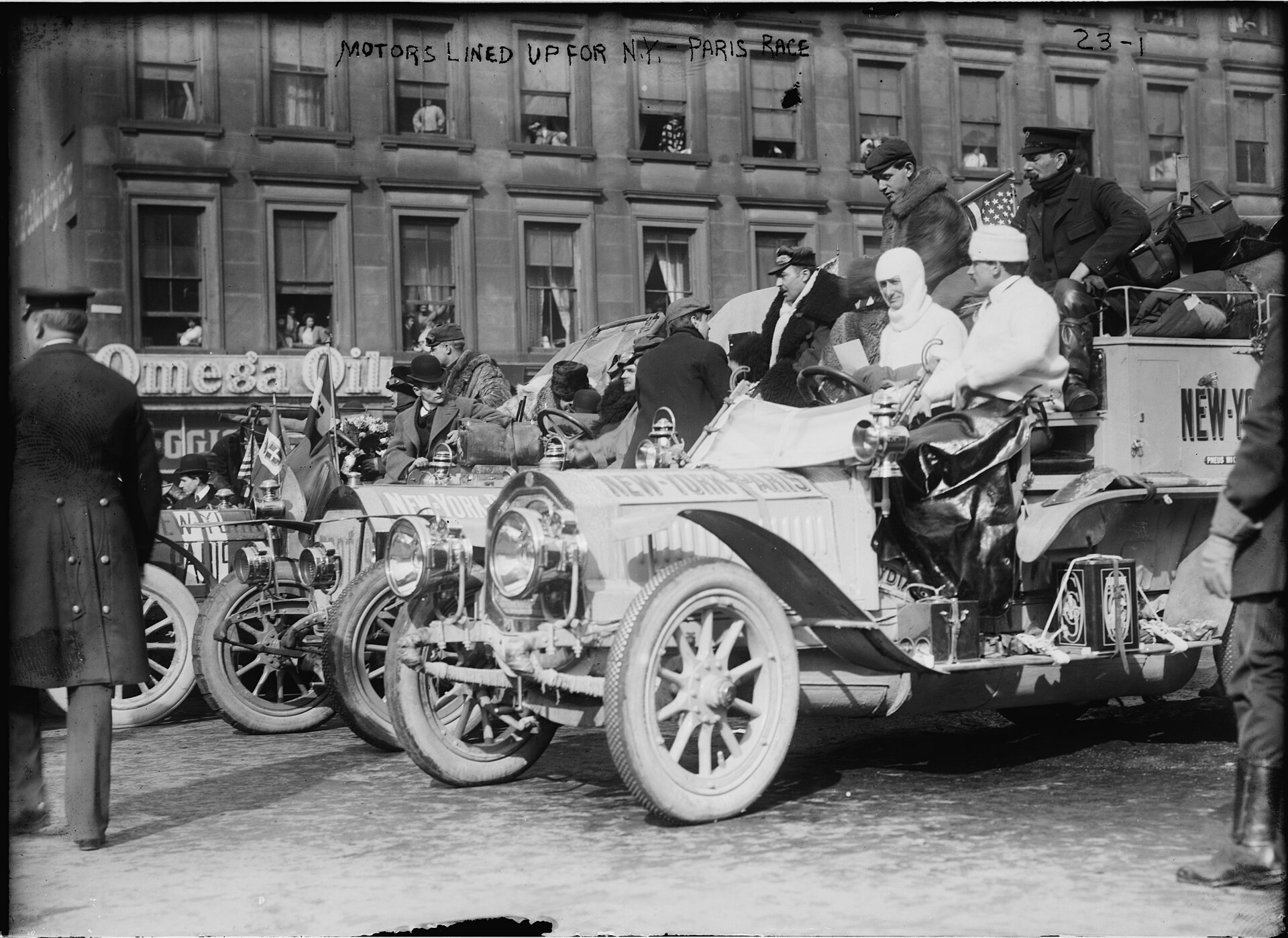
Six cars leave Times Square for Paris by travelling west, aiming for Alaska, a frozen Bering Strait and Siberia in an age when much of the route has no roads.
Paris was east of New York. The race went west.
On Wednesday, 12 February 1908, six automobiles representing four nations assembled in Times Square.
Their destination was Paris.
Their direction was west.
The race, promoted by Le Matin and The New York Times, proposed to cross the United States, turn north through Alaska, drive over the frozen Bering Strait, continue across Siberia and Europe, and finally reach the French capital.
It was an approximately 22,000-mile plan built around a geographical inconvenience: much of the route did not have roads.
The start was no more obedient than the itinerary.
New York's mayor was late, so Colgate Hoyt of the Automobile Club of America fired the starting pistol at 11:15 a.m.
The French Sizaire-Naudin retired after only 96 miles. The remaining crews fought snow, mud, mechanical failures and fuel shortages.
At times horses pulled the cars. At others the drivers used railway tracks because the rails provided the closest available substitute for a road.
The American Thomas Flyer nevertheless crossed the United States and reached Valdez, Alaska, on 8 April.
The town welcomed it. The landscape did not.
Driver George Schuster explored the proposed route by horse-drawn sleigh and concluded that the automobile could not continue unless it was dismantled and carried by dogsled.
The Alaska and Bering Strait plan was abandoned. The competitors were shipped across the Pacific and restarted from Vladivostok.
The German Protos reached Paris first on 26 July, but received a 15-day penalty for part of its journey by train.
The Thomas Flyer arrived four days later and won after receiving an allowance for the fruitless detour to Alaska.
Paris supplied one last procedural obstacle.
A police officer stopped the American car because it had no working headlamps. A cyclist's lamp was attached to the automobile, satisfying the requirement long enough for the crew to proceed.
The race had crossed three continents, survived a discarded Arctic route and changed its own rules in motion.
At the finish, it still needed a bicycle light.
A transcontinental motor race was planned through places where roads did not exist, using a frozen strait that could not be crossed; the winner was decided after route changes, railway penalties and a bicycle lamp at the finish.
The shortest way from New York to Paris was east. The most 1908 way was west through Alaska.
Evidence status
Sources
Museum record
Original language: EnglishSmithsonian history
Smithsonian Magazine — Paris or Bust: The Great New York-to-Paris Auto Race of 1908
Original language: English