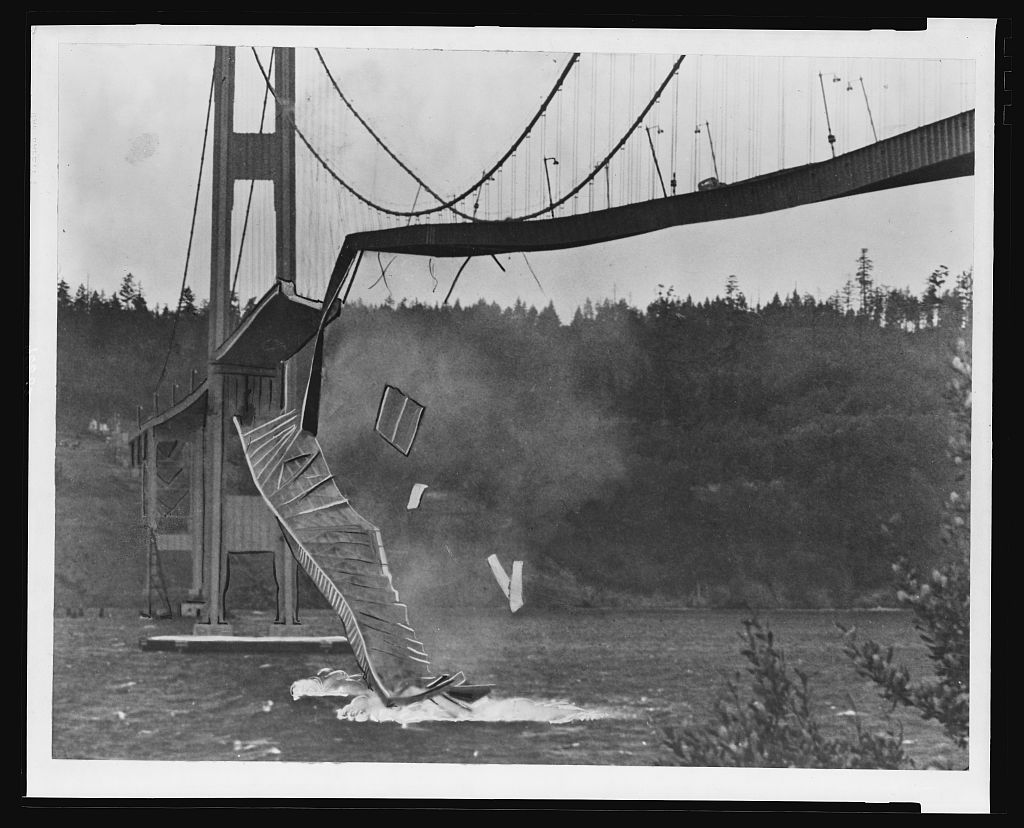
Tacoma Narrows Bridge opens as an unusually slender modern span, earns a nickname for its movement and collapses in the wind four months later.
The bridge had been moving since before it opened.
On Thursday, 7 November 1940, the Tacoma Narrows Bridge stopped being a bridge.
It had opened to traffic only four months earlier.
The suspension bridge crossed the Tacoma Narrows in Washington State with a remarkably slender, economical deck. It was elegant, modern and flexible enough to move visibly in the wind.
The bridge had been moving since before it opened.
Workers and drivers called it Galloping Gertie. Engineers tried measures intended to control the motion, while Professor Frederick Burt Farquharson of the University of Washington studied the span and filmed its behaviour.
On the morning of 7 November, a wind of about 42 miles per hour set the deck moving strongly. The familiar vertical waves then changed into a violent twisting motion: one side of the roadway rose while the other fell.
Police stopped traffic.
Leonard Coatsworth abandoned his car on the bridge after the movement became too severe to continue. His daughter’s dog, Tubby, remained trapped inside it. Attempts to rescue the frightened animal failed.
Shortly before 11 a.m., sections of the centre span broke away and fell into Puget Sound. The abandoned car went with them.
No human lives were lost.
Tubby died in the collapse.
The famous film of the failure made the event look almost unreal, but its engineering legacy was concrete. Investigations showed that long, narrow suspension bridges could interact with wind in ways that contemporary design practice had not adequately addressed.
The failure is often reduced to a simple story about resonance. The more accurate explanation centres on aerodynamic instability and torsional flutter: the bridge’s motion changed the forces acting on it, and those forces intensified the motion.
Bridge engineering changed accordingly. Wind-tunnel testing and aerodynamic behaviour became essential considerations for long spans.
Galloping Gertie therefore became both spectacle and warning.
The new bridge had advertised its flexibility from the beginning. Four months after opening, it demonstrated the limit.
A conspicuously flexible bridge acquired a nickname for moving in the wind, then collapsed only four months after opening in the very kind of motion it had been warning everyone about.
The bridge’s nickname was treated as personality. It turned out to be diagnostic information.
Evidence status
Sources
Engineering institutions
American Society of Civil Engineers — Tacoma Narrows Bridges
Original language: English