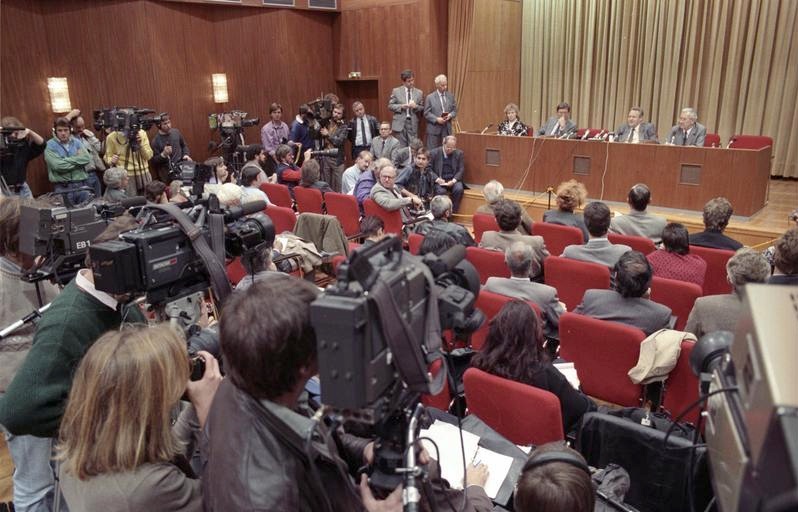
On Thursday, 9 November 1989, East Germany announced new travel rules. Then somebody asked the obvious follow-up question.
“When does that take effect?”
By November 1989, the German Democratic Republic was under enormous pressure.
Mass demonstrations were demanding political reform and freedom of movement. Thousands of East Germans had already found routes west through neighbouring countries. The government knew its travel restrictions could not continue unchanged.
On 9 November, East German officials approved a new regulation allowing citizens much greater freedom to travel abroad.
That decision itself was historic.
Its rollout became something else entirely.
That evening, Politburo member Günter Schabowski appeared at a televised press conference in East Berlin. Near the end, he read out information about the new travel regulation.
A journalist asked when it would take effect.
Schabowski consulted his papers.
His answer was, in substance, immediately — without delay.
There was a problem.
The border system was not ready for “immediately.”
German archival records show that the authorities had been preparing for the new arrangements to be handled from 10 November. Border personnel had not been properly briefed to open the crossings that evening.
But television had already carried Schabowski's answer into homes across East Germany. News organizations rapidly reported that the border was opening.
People began heading to Berlin's crossing points.
The crowds grew.
Border guards faced thousands of people demanding that the government honour what they had just heard on television. Without clear instructions and under mounting pressure, personnel at the crossings eventually began allowing people through. Bornholmer Straße opened widely that night, followed by other crossings.
The Berlin Wall did not fall because of one sentence alone.
Years of political pressure, Soviet reforms, East German protest, emigration and the deterioration of the GDR regime had created the conditions in which the Wall could no longer endure.
But history sometimes gives a vast structural crisis a remarkably small trigger.
On 9 November, that trigger was a reporter asking:
When?
A government spent months confronting a national crisis and then discovered that the implementation date mattered quite a lot.
East Germany prepared to loosen the border tomorrow. Television helped make tomorrow arrive that evening.
Evidence status
Sources
Primary / Government / Archival
German Federal Government — chronology of 9 November 1989
Bundesarchiv — November 1989 and the opening of the Wall
Bundesarchiv reunification portal — Schabowski press conference and Wall opening
Bundesarchiv photograph/document record of the press conference
Original language: German / EnglishGovernment historical analysis
German Federal Ministry of Justice — Reisefreiheit: Die Nacht, in der die Mauer fiel
Original language: GermanIndependent / Educational
Federal Agency for Civic Education (bpb) — detailed reconstruction of 9 November
Original language: German