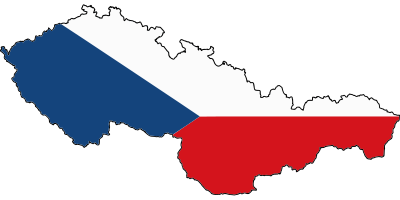
On Thursday night, 31 December 1992, millions of people went to bed in Czechoslovakia. When Friday began, their country no longer existed. There were two of them instead.
New year, new countries
Czechoslovakia had existed in various forms since 1918.
After the fall of Communist rule in the Velvet Revolution of 1989, the federal state had to answer a difficult question:
How should Czechs and Slovaks share political power in the new democratic system?
The 1992 elections intensified disagreements over the shape of the federation. Czech political forces led by Václav Klaus and Slovak forces led by Vladimír Mečiar could not agree on a mutually acceptable federal arrangement.
Political negotiations increasingly shifted from reforming the federation to ending it.
The separation was not improvised on New Year's Eve.
It was legislated.
The Federal Assembly adopted the constitutional framework for the dissolution in 1992, setting the end of the Czech and Slovak Federal Republic for the close of 31 December 1992.
Constitutional Act No. 542/1992 governed the termination of the federation.
Then midnight arrived.
Czechoslovakia ceased to exist.
On Friday, 1 January 1993, two independent states stood in its place:
the Czech Republic
and
the Slovak Republic.
Both became independent successor states from that date.
The split became widely known as the Velvet Divorce, echoing the largely peaceful Velvet Revolution that had ended Communist rule only a few years earlier.
There was no war between the two successor states.
Administrative systems, diplomatic property, military assets and other federal institutions had to be divided, but the transition itself proceeded peacefully.
Agreements signed shortly before dissolution also divided federal diplomatic property and personnel between the new states.
There was, however, a significant political caveat.
The separation was negotiated and approved by political institutions rather than decided through a nationwide referendum. Contemporary and later official histories acknowledge that part of the public wanted such a referendum.
So this was not a spontaneous midnight surprise.
Everyone involved knew the date.
But the calendar still produced an extraordinary sentence that was literally true:
People went to sleep on New Year's Eve as citizens of Czechoslovakia and woke on New Year's Day as citizens of one of two different countries.
Most countries begin January 1 by changing the year. Czechoslovakia changed the number of countries.
The calendar changed by one year. The map changed by one country.
Evidence status
Sources
Primary / Government
Original language: Czech / Slovak / EnglishOfficial Historical
Czech Ministry of Foreign Affairs — historical overview of the peaceful division and foundation of the two independent republics
Czech diplomatic material concerning 1 January and the restoration of the independent Czech state
Original language: English / CzechScholarly
Czech Sociological Review — chronology and analysis of the 1992 political negotiations and dissolution process
Original language: English / Czech