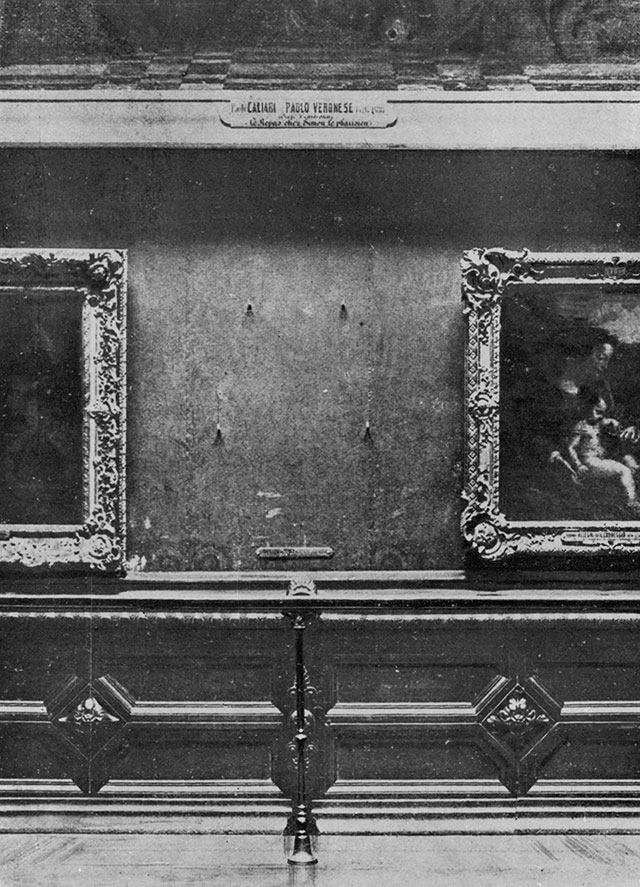
On Monday, 21 August 1911, someone removed the Mona Lisa from the Louvre. For a while, the Louvre did not realize it had been stolen.
The empty space becomes the attraction
Leonardo da Vinci's Mona Lisa was already an important painting in the Louvre in 1911.
It was not yet quite the global celebrity it would become.
That changed dramatically on Monday, 21 August.
Vincenzo Peruggia, an Italian workman who had previously worked at the Louvre as a glazier, removed the painting from the museum.
The timing helped.
The Louvre was closed to the public on Mondays.
The following morning, painter Louis Béroud arrived intending to work in the gallery and noticed that the Mona Lisa was missing. Initially, the absence did not trigger immediate panic because works could be removed temporarily for photography or other museum purposes.
Eventually it became clear that nobody in the museum had authorized this particular removal.
The painting was gone.
The Louvre closed while police investigated.
News of the theft exploded through the press, rewards were offered, suspects were questioned and the empty wall itself became an object of public fascination.
Nothing worked.
For more than two years, the Mona Lisa remained missing.
Then Peruggia attempted to return the painting to Italy.
In 1913, he contacted Florentine art dealer Alfredo Geri and offered him the work. Geri and representatives of the Uffizi verified the painting and alerted authorities.
Peruggia was arrested.
The Mona Lisa returned to the Louvre in January 1914.
Peruggia later claimed patriotic motives, saying he believed the painting ought to belong to Italy.
There was a problem with that explanation.
Leonardo had not lost the painting to Napoleon or some later French seizure. The work had entered the French royal collection centuries earlier through Leonardo's own connection with France.
Whatever Peruggia's intentions, the theft produced an unintended consequence:
It made the Mona Lisa considerably more famous.
A man stole one of the world's most famous paintings.
The theft helped make it even more famous.
A masterpiece disappeared from one of the world's most famous museums, and its absence initially looked like routine museum business.
The Mona Lisa left the Louvre unnoticed and returned internationally famous.
Evidence status
Sources
Primary / Institutional
Musée du Louvre — historical account of the Mona Lisa theft
Musée du Louvre — educational material identifying Vincenzo Peruggia and the 21 August 1911 theft
Original language: FrenchLouvre historical documentation
Louvre material concerning Louis Béroud discovering the absence on 22 August
Louvre historical account of the recovery and return of the painting
Original language: French / English