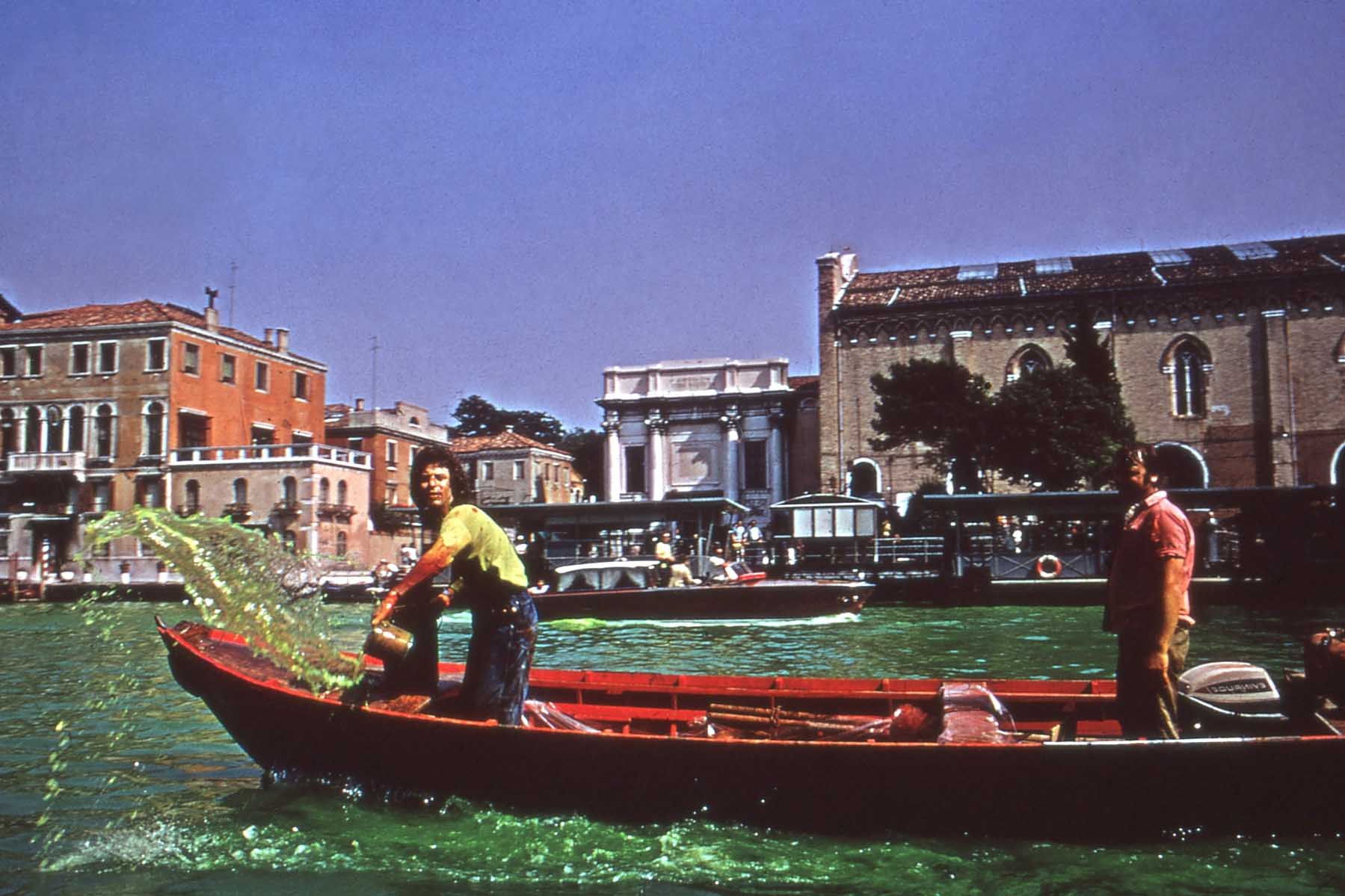
On Wednesday, 19 June 1968, people looking into Venice's Grand Canal encountered something the city had not ordered, scheduled or officially invited: several kilometres of water glowing fluorescent green.
Venice, now available in fluorescent green
The 34th Venice Biennale was opening in a year already overflowing with political protest, cultural upheaval and arguments over what art was supposed to be.
Argentine artist Nicolás García Uriburu had come to Venice without an official invitation to participate in the Biennale.
He nevertheless found himself a rather large canvas.
The Grand Canal.
On the morning of 19 June, García Uriburu boarded a gondola and released fluorescein into the water.
The effect was difficult to miss.
A long stretch of Venice's normally muted green-grey canal became intensely fluorescent, transforming one of the world's most recognizable urban landscapes into an enormous temporary artwork.
The substance had been chosen deliberately. Museum and Biennale histories describe it as non-toxic and environmentally harmless in the way it was used. The colour spread through the canal and remained strikingly visible for hours before the tide gradually carried it away.
The intervention was not an officially commissioned Biennale work. García Uriburu used the unauthorized action to challenge conventional boundaries between painting, landscape and public space, while drawing attention to humanity's relationship with nature.
Argentina's Museo Nacional de Bellas Artes later described the work as an early landmark of performance, conceptual and environmental art. The Metropolitan Museum likewise identifies García Uriburu as a pioneer of ecological art.
Venetians encountering the spectacle did not initially receive an explanatory wall label.
For a time, there was simply a famous canal in an impossible colour.
The transformation lasted only hours.
The photographs lasted considerably longer.
An artist who had not been invited to the Biennale responded by exhibiting on approximately three kilometres of Venice.
When Venice did not provide a gallery, García Uriburu used the canal.
Evidence status
Sources
Institutional / Museum
The Metropolitan Museum of Art — Coloration Uriburu
La Biennale di Venezia — historical account of García Uriburu's 1968 Actions in Nature
Museo Nacional de Bellas Artes, Argentina — Venecia en clave verde
Original language: English / Italian / SpanishArtist / Archival
Legado Nicolás García Uriburu — documentation of the Grand Canal intervention
Original language: SpanishScholarly / Secondary
Smarthistory — Nicolás García Uriburu, Coloration of the Grand Canal, Venice
Original language: English