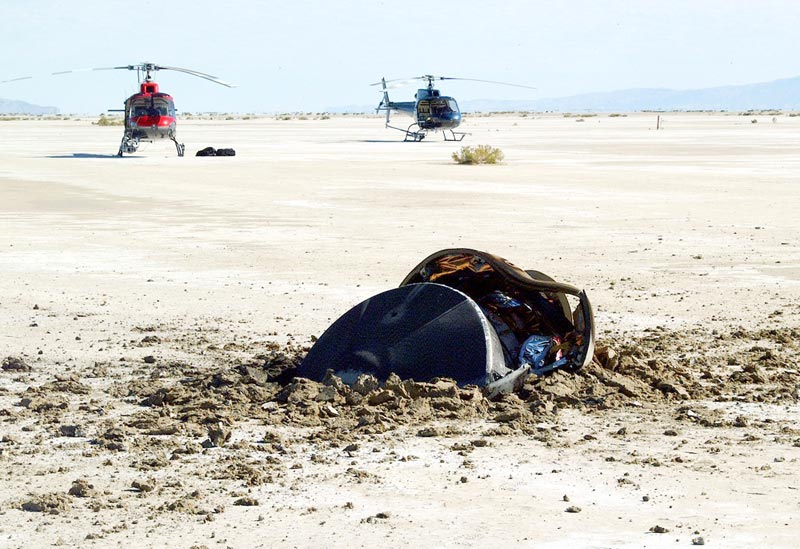
On Wednesday, 8 September 2004, NASA brought particles of the Sun back to Earth after collecting them in space for more than two years. The samples arrived successfully. Their parachute did not.
Return to sender. Some assembly required.
NASA launched Genesis in August 2001 with an unusually delicate assignment: travel to a region where it could collect particles carried by the solar wind and bring those microscopic samples back to laboratories on Earth.
For more than two years, the spacecraft exposed specially prepared collector materials to the solar wind.
The collection phase worked.
Getting the collection home was supposed to be considerably more theatrical.
On 8 September 2004, Genesis released its sample-return capsule toward Earth. The capsule was designed to descend over the Utah Test and Training Range using a staged parachute system, with recovery crews prepared for the return.
Instead, observers watched the capsule continue downward without the expected parachute deployment.
It struck the Utah desert at approximately 193 miles per hour — 311 kilometres per hour.
The capsule was badly damaged, and many of the delicate collector wafers inside shattered.
What followed was less a triumphant unpacking than an extraordinary scientific salvage operation.
Teams recovered thousands of fragments and transferred material for cleaning, identification and analysis. NASA researchers quickly became more optimistic that enough solar-wind material had survived to preserve much of the mission's scientific value.
And remarkably, they were right.
Despite the crash and contamination, Genesis samples subsequently produced significant measurements of solar-wind composition and helped scientists investigate differences between the material forming the Sun and planets. NASA continues to describe Genesis as the first mission to return material collected beyond the Moon.
The reason the parachute failed was eventually traced to something painfully terrestrial.
NASA's Mishap Investigation Board found that gravity-switch sensors responsible for initiating the parachute sequence had been placed in an inverted orientation according to an erroneous design. As a result, they could not detect the capsule's deceleration and trigger deployment.
Genesis had successfully travelled through interplanetary space, collected particles streaming from the Sun and returned them to the correct patch of Utah.
The final part proved troublesome.
Three years of spaceflight worked. The part involving the parachute did not.
Genesis crossed interplanetary space successfully and encountered its biggest problem a few kilometres above Utah.
Evidence status
Sources
Primary / NASA
NASA JPL — Genesis Mission Status Report, 8 September 2004
NASA Science / JPL — Genesis mission history
Original language: English