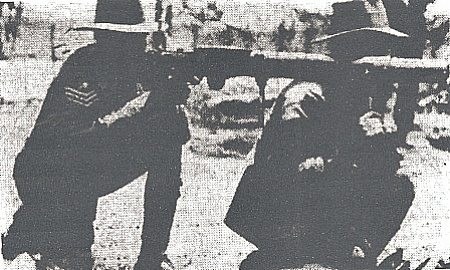
On Wednesday, 2 November 1932, Australian soldiers arrived in Western Australia's Wheatbelt to deal with a serious agricultural problem. The problem had feathers.
The military meets the emu
Western Australian farmers were having a difficult year.
Many were former servicemen who had settled on agricultural land after the First World War. By 1932 they were struggling with collapsing wheat prices during the Great Depression.
Then came the emus.
Large numbers of the native birds migrated through farming districts after breeding season, entering wheat fields, damaging crops and breaking through fences.
Contemporary estimates commonly placed the population moving through the affected districts at roughly 20,000 birds.
Farmers sought government assistance.
The response eventually reached federal Defence Minister George Pearce, and a small military detachment was authorized to assist with reducing the emu population.
On 2 November, soldiers arrived in the Campion district.
The operation rapidly demonstrated that the birds were not going to cooperate with military planning.
Emus moved quickly, scattered into smaller groups and proved difficult to contain. Early attempts produced results far below what had been expected. Newspapers soon discovered that reports of soldiers pursuing fast-moving flightless birds across Western Australian farmland practically wrote their own headlines.
After several days, the first phase of the operation was suspended.
But the emus remained.
Following renewed appeals from farmers, the military effort resumed later in November and continued into December. Even then, it did not solve the broader agricultural problem, and other approaches — including fencing and bounty programmes — remained necessary in subsequent years.
Later popular culture simplified the episode into an irresistible summary:
Australia went to war with emus, and the emus won.
That is funny, but not literally what happened.
Australia did not formally declare war on a bird species, and the emus did not sign a surrender document because, among other obstacles, there wasn't one.
What genuinely happened is almost strange enough without embellishment: during an economic crisis, the federal government deployed military personnel to help farmers control migrating birds, only to discover that conventional organization had certain disadvantages against thousands of animals whose principal tactic was simply to run away.
The military had organization, planning and government authorization. The emus had the ability to scatter.
Australia discovered that military organization is considerably less impressive when the opposition refuses to stand in formation.