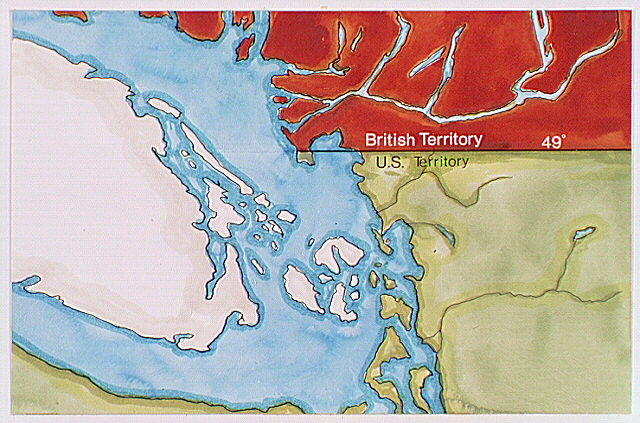
A pig raids a potato patch on a disputed island. The argument over compensation escalates into a confrontation involving American troops and British warships.
The trouble was whose country the garden was in.
On Wednesday, 15 June 1859, an unresolved international boundary dispute acquired a dead pig.
American settler Lyman Cutlar had found it rooting in his garden on San Juan Island. The animal belonged to the Hudson’s Bay Company, whose nearby farm was managed by Charles Griffin.
Cutlar shot it.
The trouble was that nobody had settled whose country the garden was in.
Britain and the United States had signed a boundary treaty in 1846. Its description of the waterway separating their territories left room for competing interpretations, with the San Juan Islands caught between them.
Both sides claimed the islands. British commercial interests and American settlers were already testing those claims on the ground.
The pig supplied the immediate grievance.
Cutlar and Griffin failed to settle compensation. British authorities threatened arrest and the removal of American settlers. The Americans sought military protection.
In July, U.S. troops under Captain George Pickett landed on San Juan Island. British warships followed. Reinforcements turned a garden dispute into an armed international standoff.
Fortunately, the confrontation did not become a shooting war. British naval commanders resisted escalation, and General Winfield Scott helped negotiate a temporary arrangement.
Joint occupation followed. Arbitration finally settled the boundary in favour of the United States in 1872.
The pig had not created the territorial dispute. But it had exposed how much unfinished diplomacy could fit inside a potato patch.
An argument over one dead farm animal escalated into a military confrontation between two countries that had signed a border agreement without resolving which channel it followed.
The border needed clarification. The pig was an unnecessarily expensive way to request it.