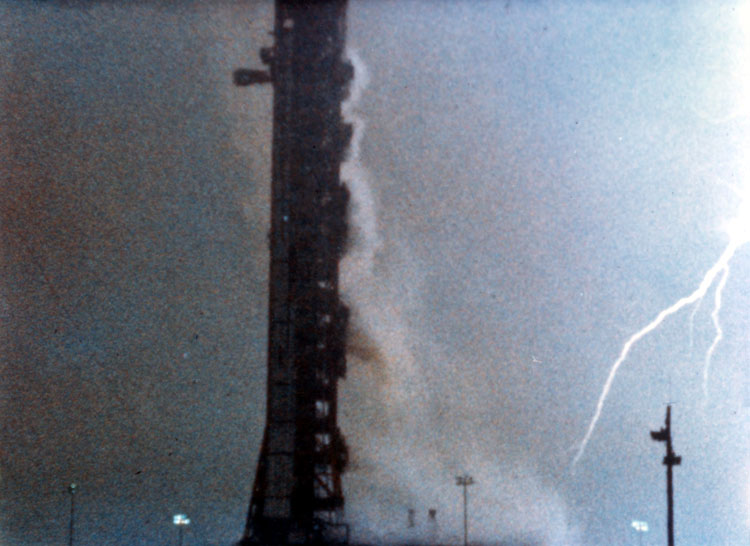
Apollo 12 launched toward the Moon, triggered two lightning strikes within its first minute, scrambled its spacecraft electronics—and kept going.
The Saturn V itself kept flying.
On Friday, 14 November 1969, Apollo 12 lifted off from Kennedy Space Center with Pete Conrad, Richard Gordon and Alan Bean aboard.
The weather was miserable.
The mission was still going.
Then, 36.5 seconds after liftoff, something lit up the sky.
Lightning.
Inside the spacecraft, warning lights appeared and several electrical systems went offline. Mission Control’s telemetry became largely unreadable.
The Saturn V itself kept flying.
Sixteen seconds later came another major electrical disturbance.
For the second human mission intended to land on the Moon, this was not an especially reassuring first minute.
Apollo 12 had not simply wandered into an ordinary thunderstorm already producing lightning. NASA’s subsequent investigation concluded that the launch vehicle and its long exhaust plume had probably triggered the electrical discharges while passing through clouds containing strong electric fields.
Mission Control now had a spacecraft still accelerating toward orbit while its instrument readings had become extremely difficult to interpret.
Flight controller John Aaron recognized the pattern.
He suggested switching the spacecraft’s Signal Conditioning Electronics to its auxiliary setting.
Astronaut Alan Bean located the switch.
Useful telemetry returned.
The spacecraft had not escaped completely unharmed. Nine non-essential instrumentation sensors were permanently lost, but its critical systems remained capable of continuing the mission.
Once Apollo 12 reached Earth orbit, NASA spent considerable time checking the spacecraft before committing it to the Moon.
The systems proved healthy enough.
Mission Control gave the crew permission to continue.
Five days later, Conrad and Bean landed the lunar module Intrepid in the Ocean of Storms.
Apollo 12 had therefore managed an unusual sequence of milestones:
Launch toward the Moon.
Get struck by lightning.
Get struck by lightning again.
Recover.
Continue to the Moon.
Land.
NASA’s investigation produced a more permanent consequence on Earth. Launch-weather rules were revised to address the kind of electrically charged cloud environment that had allowed the Saturn V to trigger lightning in the first place.
The second crewed mission headed for a lunar landing spent its first minute triggering two lightning events, briefly scrambling the spacecraft’s electrical picture, then continued all the way to the Moon.
Apollo 12 discovered that “Go for launch” and “excellent lightning rod” were not mutually exclusive.
Evidence status
Sources
Institutional history
NASA Science — Lightning Strikes Twice
NASA — 55 Years Ago: Apollo 12 Makes a Pinpoint Landing on the Moon
Original language: English