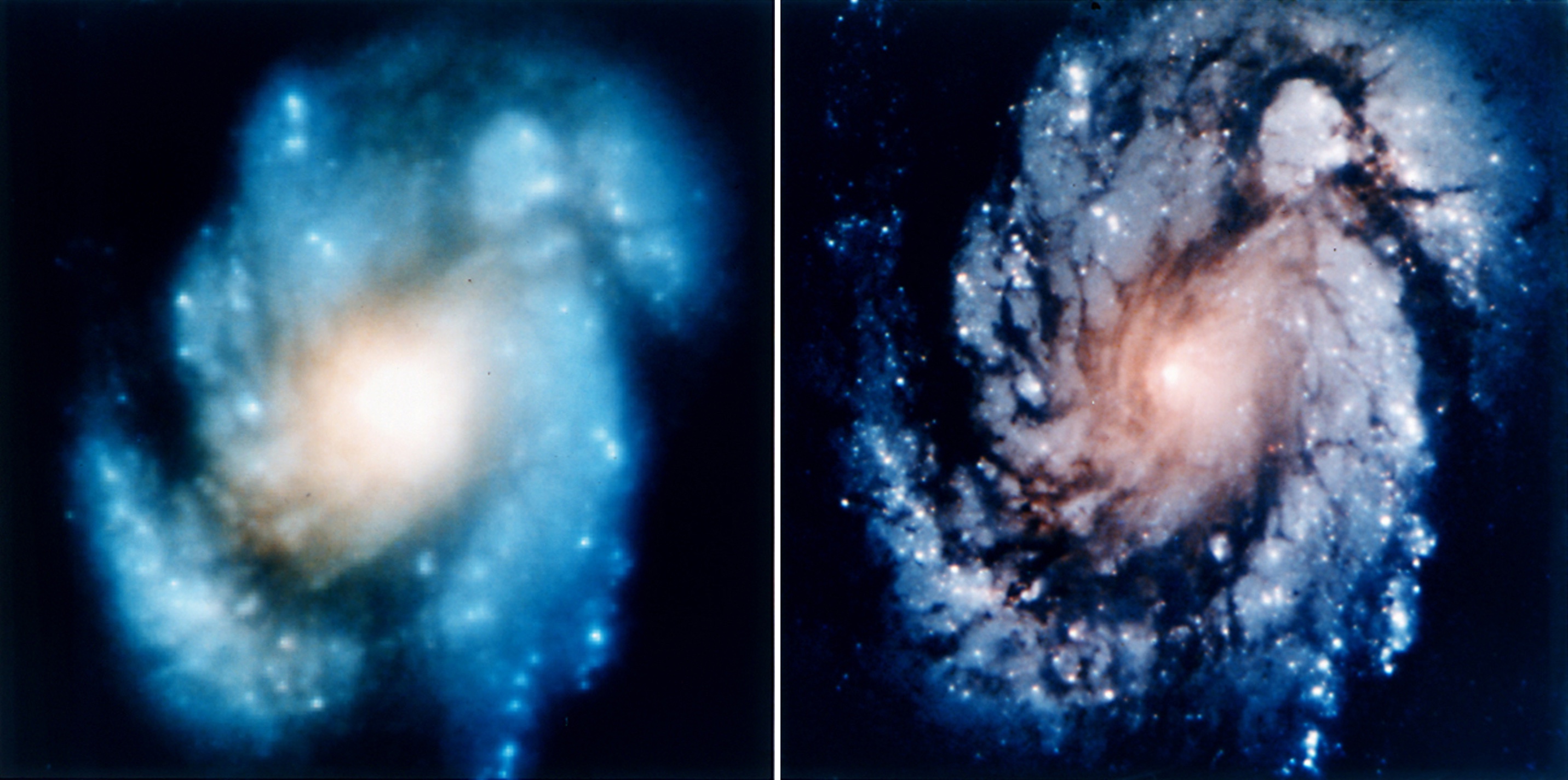
Two months after launching one of history’s most ambitious telescopes, NASA tells the world that its primary mirror has been manufactured to the wrong shape.
The telescope could see the universe. Unfortunately, it could not focus on it properly.
Hubble was supposed to remove one of astronomy’s oldest problems.
Earth’s atmosphere distorts incoming light. Put a large precision telescope above the atmosphere, and astronomers should receive extraordinarily sharp images of the universe.
NASA launched the Hubble Space Telescope in April 1990.
Then the first pictures arrived.
They were blurry.
Engineers initially investigated several possible causes, but by late June the evidence pointed toward a much more uncomfortable explanation: something was wrong with the telescope’s optical system itself.
On Wednesday, 27 June 1990, NASA announced the problem publicly.
Hubble’s primary mirror suffered from spherical aberration. Its outer region had been shaped too flat, so incoming light did not converge at the single focus the telescope required.
The error was astonishingly small in ordinary terms and enormous in precision optics.
NASA later traced the failure back to equipment used while the mirror was being manufactured. A device called a null corrector had been assembled incorrectly. NASA’s investigation found a spacing error of approximately 1.3 millimetres in the testing apparatus.
That tiny setup error helped produce a mirror whose shape was wrong enough to compromise the performance promised for one of the most sophisticated scientific instruments ever placed in orbit.
Hubble was not useless. It could still perform valuable observations, and engineers quickly understood the aberration well enough to compensate for some of it computationally.
But the telescope could not simply be brought back to the factory.
The eventual solution was more elegant.
Engineers designed corrective optics that compensated for the flawed mirror—essentially giving Hubble optical correction in space. Astronauts installed the new equipment during the first servicing mission in December 1993.
The result transformed the telescope.
Hubble went on to produce some of the most important and recognizable astronomical observations in modern science.
Which means one of astronomy’s greatest success stories began with a Wednesday press conference explaining that the giant precision mirror already orbiting Earth had been made to the wrong shape.
The problem was not that humanity could not launch a large telescope into space. It was that a millimetre-scale setup error in equipment on Earth helped give its mirror the wrong figure.
Hubble reached orbit successfully. Its first major repair was effectively a prescription for glasses.
Evidence status
Sources
Primary / Institutional
NASA Science — Hubble’s Mirror Flaw
NASA Technical Reports Server — Hubble Space Telescope Optical Systems Failure Report
Original language: English