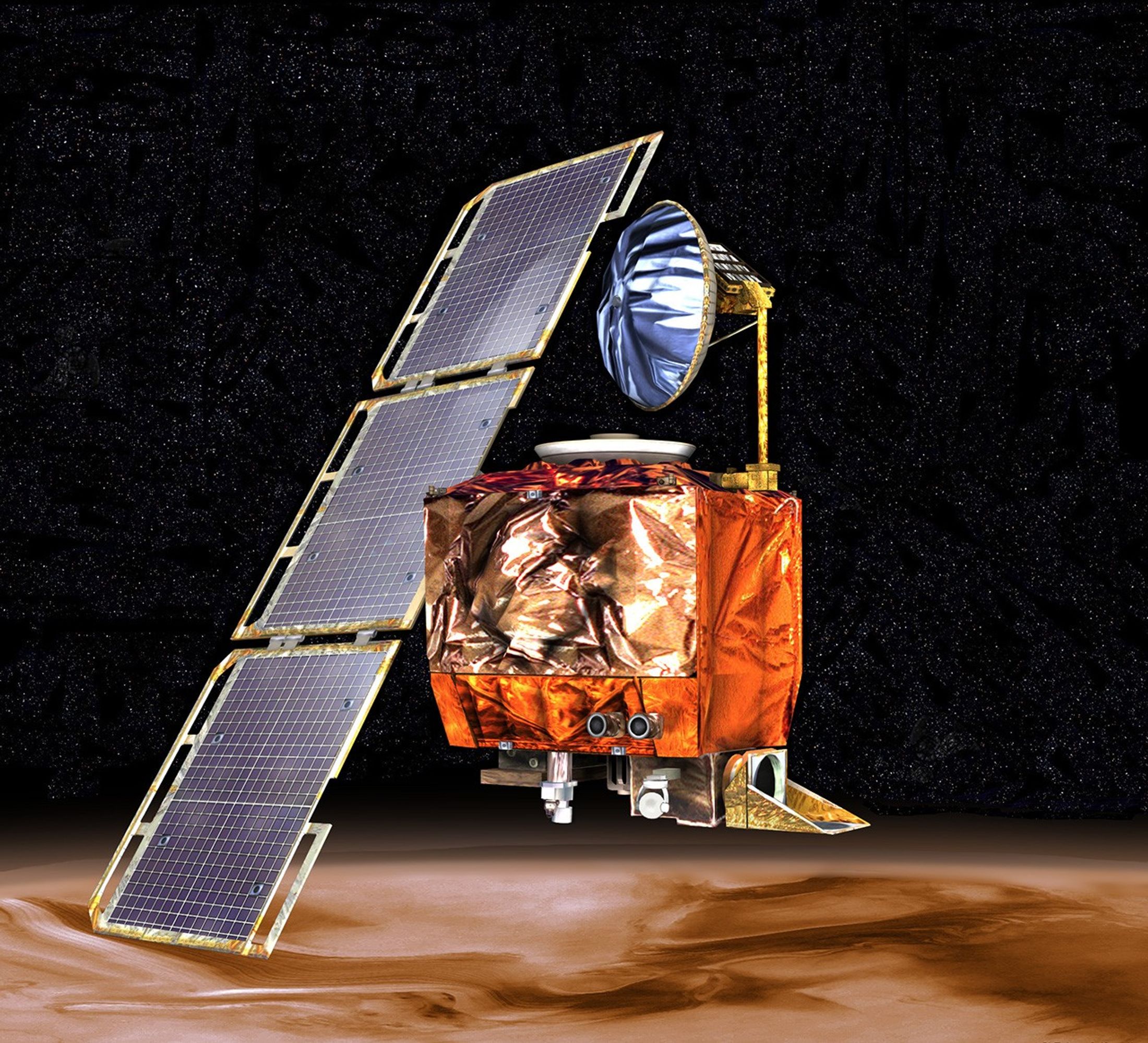
NASA’s Mars Climate Orbiter reached Mars after a nine-month journey. A mismatch between measurement units sent it much lower than planned.
The measurements had not crossed the office boundary quite so successfully.
On Thursday, 23 September 1999, NASA’s Mars Climate Orbiter reached the planet it had spent nine months travelling toward.
It had crossed interplanetary space.
The measurements had not crossed the office boundary quite so successfully.
The spacecraft was intended to study Martian weather and relay communications. As it approached Mars, it fired its main engine to enter orbit.
Passing behind the planet would temporarily interrupt radio contact. That part was expected.
The signal disappeared approximately 49 seconds earlier than predicted.
It never returned.
Investigators traced the loss to a mismatch in ground-software data. The Lockheed Martin spacecraft team in Colorado supplied figures describing the effect of small thruster firings in pound-force seconds. The JPL mission navigation team in California used software that expected metric newton-seconds.
Both measured the same physical quantity.
They did not use the same numerical scale.
The incorrect values fed into navigation calculations over the journey. By arrival, the spacecraft’s actual trajectory took it much closer to Mars than intended.
NASA’s review identified the failure to use the required metric units in a ground-software file as the root cause. But the investigation did not stop at the conversion.
The mission’s checks, testing and communication had failed to catch the mismatch.
That is what makes this more than a story about somebody choosing the wrong units.
A complex engineering organization had a specified interface, multiple teams and an interplanetary spacecraft—and still allowed incompatible numbers to pass through a critical navigation process.
The spacecraft reached Mars.
The shared understanding of its measurements did not.
An interplanetary mission was lost because two connected engineering systems interpreted the same numbers using different units—and the safeguards failed to notice.
The mission crossed the distance between planets. The measurements failed to cross the distance between teams.
Evidence status
Sources
Primary / NASA mission reports
Original language: EnglishInvestigation / Lessons learned
NASA Technical Reports Server — Mars Climate Orbiter Mishap Investigation
NASA — Mars Climate Orbiter Mishap Investigation Board Phase II Report
Original language: English