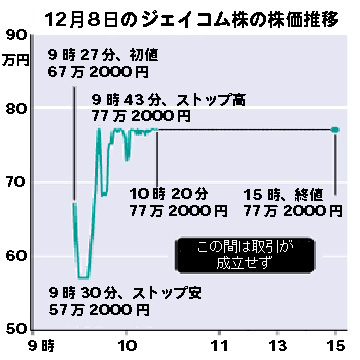
On Thursday, 8 December 2005, a securities trader in Tokyo entered two perfectly ordinary numbers into a computer. Unfortunately, they went into the wrong boxes.
Quantity: 610,000. Price: ¥1.
J-Com Co., a Japanese recruitment-services company, was making its debut on the Tokyo Stock Exchange's Mothers market.
A client had instructed Mizuho Securities to sell one share for ¥610,000.
The order entered into the system said something rather different:
Sell 610,000 shares for ¥1 each.
The reversal was difficult to overlook mathematically. J-Com had only about 14,500 shares outstanding, meaning the sell order represented more than forty times the entire company.
The trading system also generated a warning.
The order nevertheless proceeded.
Once Mizuho realized what had happened, it attempted repeatedly to cancel the order. That produced a second problem: a defect in the Tokyo Stock Exchange's system prevented the cancellation from taking effect.
Traders noticed.
J-Com's share price plunged to its permitted daily lower limit as buyers rushed toward what was obviously an abnormal order, then rebounded sharply as Mizuho attempted to buy shares back. The disturbance spilled into the wider Tokyo market.
One important detail should not get lost in the joke.
Nobody actually acquired 610,000 J-Com shares for ¥1 apiece. Exchange price-limit rules prevented transactions at that absurd price. The mistake was the order instruction; executions occurred at allowable market prices.
Untangling the damage was expensive.
Mizuho Financial Group later reported a ¥40.7 billion loss arising from the erroneous order. Because far more shares had effectively been sold than physically existed, the Japan Securities Clearing Corporation eventually imposed a special cash settlement price of ¥912,000 per share for the affected positions.
The dispute did not end with the trading day. Mizuho later sued the Tokyo Stock Exchange, arguing that the exchange's system failure prevented cancellation of the erroneous order. The litigation ultimately involved damages measured in the tens of billions of yen.
All because two fields contained the correct numbers in the incorrect order.
The difference between ¥610,000 and ¥1 was not the problem. The difference between “price” and “quantity” was.
The numbers were correct. Their locations cost ¥40.7 billion.
Evidence status
Sources
Institutional / Primary
Nikkei Indexes — retrospective history of the 8 December 2005 J-Com trading error
Japan Exchange Group / Tokyo Stock Exchange corporate documentation concerning the erroneous order and subsequent litigation
Japan Securities Clearing Corporation — special settlement documentation
Original language: English / JapaneseContemporary / Independent
Japan Times — contemporary reporting on the erroneous order and aftermath
Original language: EnglishLegal / Reference
University of Tokyo securities-law case summary documenting the order and failed cancellation
Original language: English / Japanese