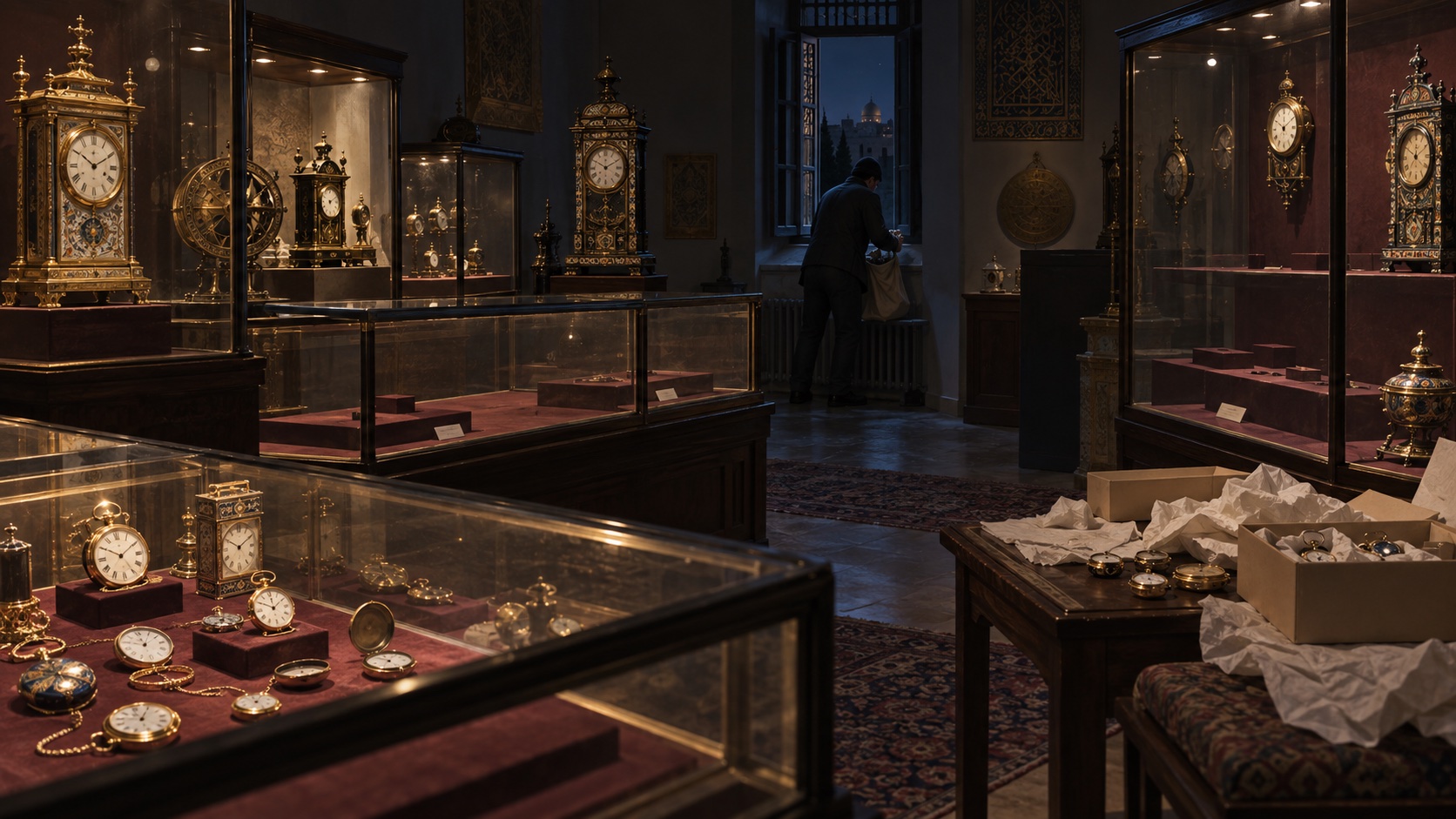
A Jerusalem museum loses 106 rare clocks and watches in one night. The apparent team of master thieves turns out to be one burglar whose deathbed confession eventually leads back to the collection.
The number of missing clocks suggested a team. There was no team.
On Sunday morning, 17 April 1983, employees of Jerusalem’s Museum for Islamic Art arrived to find a substantial problem with the watch collection.
One hundred and six clocks and watches had disappeared.
The missing objects came from the celebrated collection of Sir David Salomons. They included dozens of works by Abraham-Louis Breguet and the collection’s most famous object: the elaborate watch known as the Marie Antoinette.
That watch had itself taken decades to complete. Commissioned in 1783, it was finished in 1827—thirty-four years after Marie Antoinette’s execution and four years after Breguet’s death.
Now it was missing too.
The scale of the robbery suggested an organized team. The collection was enormously valuable, larger clocks had been dismantled, and the objects had to be moved through a narrow rear window.
Police, Interpol, private investigators and even Mossad searched without solving the case.
For more than two decades, the museum’s empty cases remained where the watches had been.
Then, in August 2006, a Tel Aviv art dealer told the museum that he had encountered some of the stolen pieces. A lawyer soon contacted the museum on behalf of an anonymous woman who had inherited clocks from her late husband.
Thirty-nine items, including the Marie Antoinette watch, were initially returned after negotiations.
The woman was Nili Shamrat. Her late husband was Naaman Diller, a resourceful burglar who had confessed shortly before dying in 2004.
There had been no organized team.
Diller had entered the museum alone, bypassed its security, dismantled objects where necessary and moved the collection through the small window. He then hid the watches in safes and deposit boxes across several countries.
Investigators subsequently recovered more of the collection. In total, 96 of the 106 stolen timepieces were found; ten remained missing.
Diller had sold remarkably few. He had also kept notes about individual mechanisms and preserved many pieces with the attention of somebody who appeared to admire the objects he had stolen.
The museum restored the recovered watches and reopened the Salomons collection to the public in 2009.
The crime had removed 106 instruments designed to measure time.
Solving it required twenty-three years and one very delayed explanation.
A theft enormous enough to suggest an organized gang was performed by one burglar, remained unsolved for more than two decades and was finally exposed after he left the stolen clocks to his widow.
The watches kept time. The investigation required rather more of it.
Evidence status
Sources
Museum record
Original language: EnglishIndependent historical account
Smithsonian Magazine — The Time Thief Who Stole 106 Rare Clocks · 14 April 2023
Original language: English