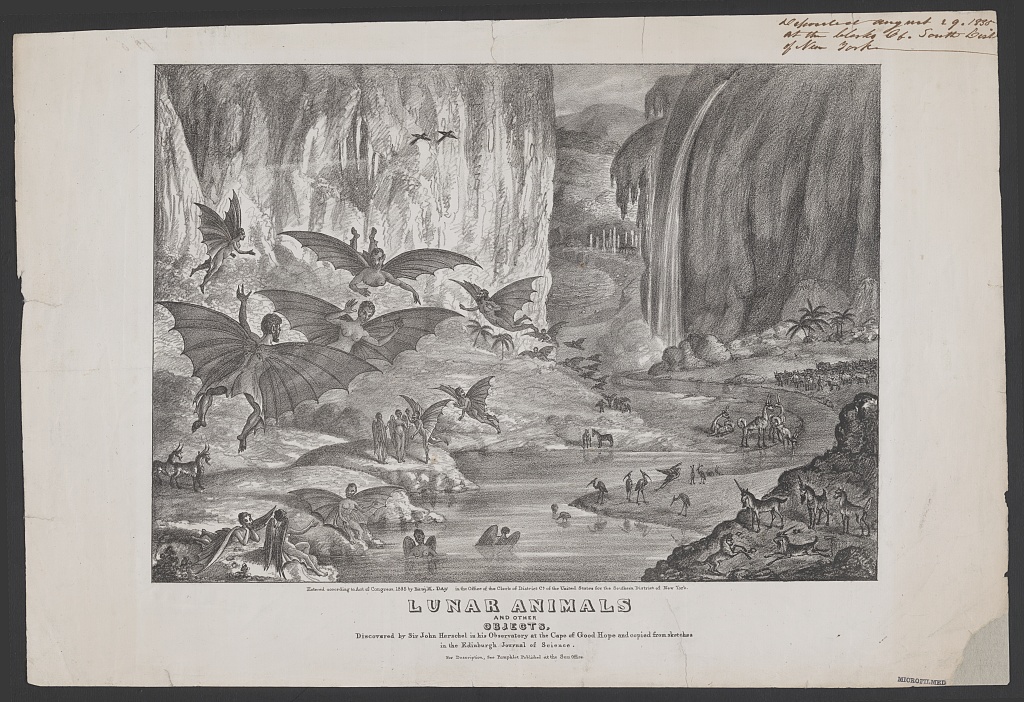
On Tuesday, 25 August 1835, readers of a New York newspaper learned that life had been discovered on the Moon. There were animals. There were forests. Eventually, there were bat people.
Extraordinary discoveries, conveniently unavailable for verification
New York's penny press was young, competitive and hungry for readers.
On 25 August 1835, The Sun began publishing what it presented as extraordinary astronomical news.
The articles claimed that Sir John Herschel, one of the world's best-known astronomers, had made astonishing discoveries while observing the southern sky from the Cape of Good Hope.
Using a fantastically powerful new telescope, readers were told, Herschel had observed the lunar surface in unprecedented detail.
The series did not begin immediately with flying humanoids.
That would apparently have been too abrupt.
The first installment established the telescope and the supposed scientific credentials behind the discoveries.
Then the Moon became increasingly populated.
Later installments described vegetation, lakes and animals, including creatures resembling bison, goats, unicorns and tailless beavers.
Eventually came the most memorable inhabitants:
winged humanoids — often remembered as the lunar bat people.
The articles were supposedly written by a Dr. Andrew Grant and based on Herschel's discoveries.
There was a difficulty.
Grant was fictional.
Herschel had made no such discoveries.
And the scientific journal from which the material was supposedly derived was not publishing the account.
The series was a fabrication, generally attributed to Sun reporter Richard Adams Locke.
Yet the hoax worked remarkably well.
People around the world became interested in the supposed lunar inhabitants, and the stories attracted enormous attention to The Sun.
Part of the success came from presentation.
The reports were written in the language and structure of serious scientific journalism. The fantastic discoveries arrived gradually, wrapped in technical detail and attached to the name of a genuine celebrated astronomer.
The hoax also arrived at a moment when the limits of telescopic observation were not obvious to ordinary newspaper readers.
A powerful enough telescope might sound capable of revealing extraordinary things.
For several days, New Yorkers opened their newspaper and received progressively more detailed updates from a civilization that did not exist.
The series ran through six installments.
Its first step onto the Moon happened on Tuesday.
The Moon acquired an ecosystem because a newspaper discovered that scientific vocabulary made excellent camouflage for fiction.
The Sun discovered life on the Moon before astronomy had the equipment to prove otherwise to its readers.
Evidence status
Sources
Institutional / Primary
Library of Congress — Peoples & Creatures of the Moon
Library of Congress — original 1835 Great Moon Hoax material and illustrations
Library of Congress — historical teaching collection concerning the six-part series
Original language: English