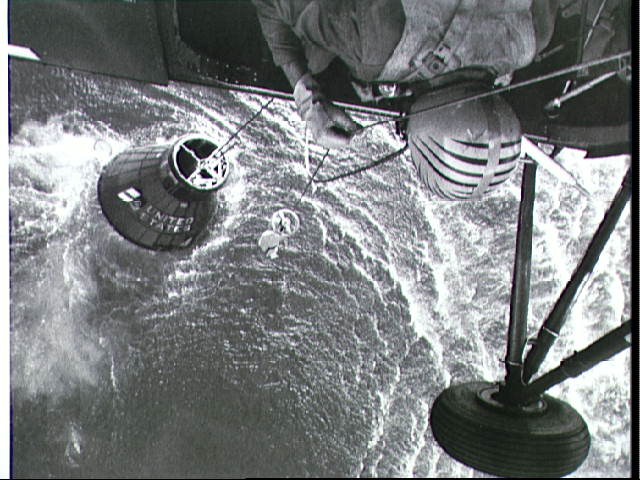
Gus Grissom completes America’s second crewed spaceflight. Minutes after splashdown, Liberty Bell 7’s hatch opens unexpectedly and the capsule sinks.
The experimental spaceflight succeeded. The recovery did not.
On Friday, 21 July 1961, astronaut Virgil “Gus” Grissom climbed aboard Liberty Bell 7 at Cape Canaveral.
Fifteen minutes and thirty-seven seconds later, America’s second crewed spaceflight was essentially complete.
The flight had gone well.
Grissom had travelled on a suborbital arc, reached an altitude of roughly 118 miles and guided the Mercury capsule through the mission’s manual-control tasks before returning through the atmosphere.
Liberty Bell 7 descended beneath its parachute and splashed into the Atlantic, 302 miles east of the launch site.
NASA now had one astronaut back from space and one spacecraft floating where recovery crews expected to find it.
Then the hatch opened.
The Mercury capsule used a newly designed explosive side hatch intended to provide a rapid exit. While Grissom waited for helicopter recovery, that hatch activated prematurely.
Water began entering the capsule.
Grissom got out. Liberty Bell 7 stayed behind and became progressively heavier as seawater filled it.
A recovery helicopter tried to lift the capsule, but the waterlogged spacecraft was too heavy. With the helicopter itself running into difficulty, its crew had to release it.
Liberty Bell 7 sank in about 15,000 feet of water.
Grissom was recovered safely after several minutes in the Atlantic.
NASA’s second human spaceflight had therefore completed its actual spaceflight successfully, returned its astronaut to Earth successfully—and lost the spacecraft during the part where somebody was supposed to pick it up.
For nearly thirty-eight years, the capsule remained about three miles beneath the Atlantic. A recovery expedition brought Liberty Bell 7 back to the surface in 1999.
The exact reason its explosive hatch activated prematurely has never been conclusively established. Later evidence undermined early suspicions that Grissom had deliberately or accidentally fired it himself.
The spacecraft survived launch.
It survived space.
It survived re-entry.
It survived splashdown.
It did not survive waiting for the helicopter.
The dangerous experimental spaceflight succeeded. The spacecraft was lost after it was already safely back on Earth.
Liberty Bell 7 conquered space and was defeated by the recovery operation.
Evidence status
Sources
NASA mission records
Original language: EnglishDocumentary image and historical account
NASA Astronomy Picture of the Day — Liberty Bell 7
Smithsonian National Air and Space Museum — The Sinking of Liberty Bell 7
Original language: English